
In the sharpening world the term angle is thrown around a lot, and rightfully so. The angle at which your knife is sharpened is an important step in the sharpening process and understanding how to keep your knife sharp.
What is edge angle?
Simply put, the edge angle is the angle at which the cutting edge is cut into the side of the knife to form the sharp tip. It's measured from the centerline of the knife (indicated by the tip) to the outer edge of the spine. The image below will help explain.

Edge angle can be measured per side (as described above), or inclusive, measuring the angle that the tip itself forms in its entirety to both sides. We usually talk about angles per side, as that is more relevant to sharpening.
What angle is best for my knife?
Knives are built for specific uses. Kitchen knives for slicing mean and veggies, pocket knives for daily tasks like opening packages, cutting rope, or fetching slivers, and other outdoor knives meant for blazing trails, making camp or splitting wood. With each intended use there is a range of angles that are typically used for these jobs.
Kitchen knives use finer angles for slicing and detailed trimming, usually between 15 and 18 degrees.
Pocket knives are usually between 17 and 25 degrees making them a bit more sturdy and holding up to a day's work.
Outdoor camping and bush crafting blades are usually 25 to 35 degrees.
As an angle gets wider the edge grows stronger. More metal is left closer to the cutting edge and will support the edge as it makes a cut, or chop. Thinner angles like 15 degrees, are fragile and the edge will roll to one side or the other with heavy use. Kitchen knives with thin angles will slice smooth and fall through veggies and camp knives with wide angles like 30 degrees will only split the veggies, even when sharp the width of the spine will split an object before the tip can make an effective cut.
Sharpening a knife for the first time, what is the existing angle?
Maintaining the original geometry of a knife is important. The angle of the edge is often selected based on the width of the knife and the intended use of the blade. Most knives are sharpened by hand on large machines in the factories meaning angles are not exact. So how do I determine the angle of my knives?
There is a tool called a Goniometer - it shines a laser at the edge and the laser reflects onto a graduated circle with markings to indicate the angles. Most of us don't own one of these, so here's a more practical way to test.

Another Sharpie trick. Color the bevel of the knife with sharpie. One pass down the bevel on each side should be enough to cover it, make sure you coat the bevel from the tip all the way to the primary grind, or the shoulder. Usually this is about 1/8" or 3/16". Color both sides of the bevel. Then use your sharpener and set it to an angle that you believe is close to what you might expect for the knife, use the reference above as a place to start. If you do not have a sharpener with different angle options for sharpening perhaps consider using a reference piece of material as a place to start such as stacking coins, or cutting a small wedges of wood at specific angles and laying them on a diamond or stone sharpener. Whatever you choose, make sure it's consistent, that is the key with any sharpening.

Draw the knife across a fine abrasive with light pressure. The goal is not to sharpen, yet, but to remove only the sharpie markings to indicate which angle. After 2-3 strokes per side inspect you bevel and the sharpie markings. If the sharpie is worn away on the upper portion of the bevel you are sharpening too flat (ie, sharpening at 15 degrees and the knife may have a 20 degree angle). If you are only making contact at the cutting edge you are sharpening too steep (ie, sharpening at 20 degrees and the angle of the knife is 15 degrees). Adjust the angle to accommodate your knife and make a few more strokes per side. This may take 2-3 adjustments before getting close enough to feel confident sharpening your knife.

A practical note: many sharpeners have 2 options for angles offering either 20 and 25 degrees, or 15 and 17 degrees. Use this method to determine which of the two options is closer to the angle on your blade, then use that option even if it is not exact. An angle within a few degrees of the manufacturer's angle is close enough for any practical knife use. And if you're a bit pickier than that, you can always find yourself a new sharpener with more versatility. We're happy to make a recommendation.
Is there one angle to rule them all?
No. Knives and the angles they are sharpened to are created for specific uses and jobs. Factoring in the purpose of the knife, the steel used, and the user's preference, there is no angle that is the best all-around.
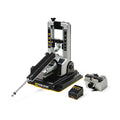
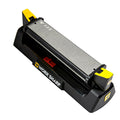
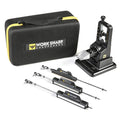
Looking to sharpen your knife to a specific angle? These are some of our most popular sharpeners.
Find the best sharpener for me
Answer a few quick questions and we'll match you to the ideal Work Sharp sharpener.

Subscribe for sharpening tips & updates
Join the Work Sharp email list for guides, new products and offers.